
Die Berliner Mauer — The Berlin Wall
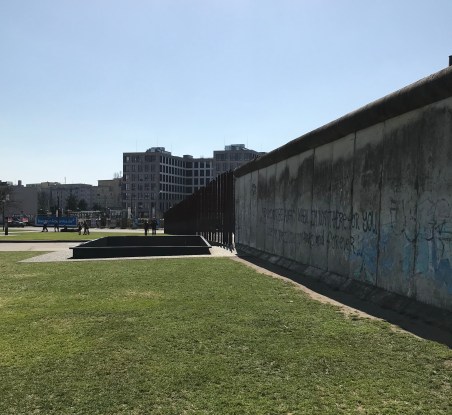
One of the most significant and impactful events experienced by Berliners was die Berliner Mauer The Berlin Wall. The wall is not a distant memory. It is visible and powerfully striking.
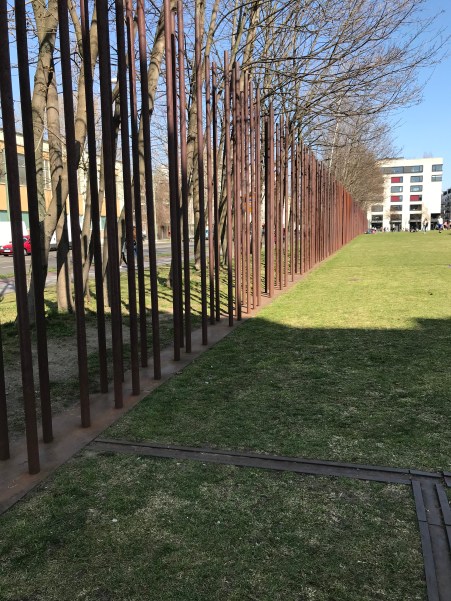
On my first day traveling from the main Berlin train station to my apartment, the journey took me via Bernauer Strasse. I noticed columns of narrow iron posts and what appeared to be green walking paths. I knew almost immediately I was experiencing traces of the Berlin Wall. I knew this would be a path I would spend time to explore.

The Berlin Wall appeared overnight on August 13 1961. Berliners woke up to 23 miles of barbed wire strung through Berlin, separating East from West Berlin. Within two weeks a concrete block wall emerged. Overtime additional obstacles continued to be added. In my second post on the wall I will provide a more detailed physical description of the ‘wall’.
It was the most concrete and enduring symbol of the Cold War.
Die Berliner Mauer has its origins in the outcomes of the Potsdam Peace Conference. The victorious Allied forces determined that Germany’s territories should be split into four ‘allied occupation zones’. The Eastern part of Germany went to the Soviet Union and the Western parts to the US, Great Britain and France. Berlin was centrally located in East Germany.
As Berlin was the capital and home to the defeated Hitler, it had particular significance to the allied powers and so it too was divided into 4 sectors,(Soviet, US, British and French) even though the city itself was well into Soviet controlled East Germany. The four way occupation began in 1945.

With hindsight we might ask “ what were they thinking?” Tensions between the allied forces had existed even during the final days of the war. In the ensuing years tensions continued. Over time West Berlin had become a conspicuously capitalist city deep within communist East Germany. In the years following the formation of East and West Germany, a seemingly endless flow or refuges ( millions, many of them young skilled professions ) moved from the eastern communist sector, the GDR, officially known as the German Democratic Republic to west Germany the Federal Republic of Germany.
By the 1960s the waves of defections were an embarrassment and economically damaging. Many were existing through Berlin. In June 1961, some 19,00 people left the GDR through Berlin. In July 30,000 followed. On the 12th of August, 2,400 left– the largest number ever to leave on a single day. On August 13th The GDR erected Die Berliner Mauer.
The wall stood for 28 years until November 9, 1989.
Before the wall was built Berliners on both sides of the city could move freely from east to west. They crossed to work, shop, go to school, church, the theatre and movies. Trains, trams and subway lines passed back and forth across the border. Once the wall was built, it became impossible to get from East to West Berlin except through three checkpoints. Checkpoint Alpha, Checkpoint Brava and Checkpoint Charlie. Travelers were screened by East German soldiers on the east and US, British or French soldiers on the West. Citizens of East Germany were not allowed to travel to West Berlin.
My first experience with the Berlin Wall came when I was 21. I was studying in Munich. The West German government provided an all-expenses paid weekend in Berlin for students from Canada and America. Clearly, they did not want the west to forget the challenges in Germany and particularly Berlin. We crossed over into East Berlin through Checkpoint Charlie. While I don’t have as vivid a recollection as I would like, I recall that East Berlin (now under communist rule for over 25 years) was bleak and stark. There were big empty spaces Signs of the war bombings were still very much in existence—it was clearly a city that continued to need to rebuild. The city did not feel whole. The subway had stops that were boarded up and you could not exit as they were in East Berlin.
On our second day into East Berlin, we happened to come upon a group of young east Berlin students. Well perhaps given we were mostly female and they were a group of young men, maybe not so surprising. They were eager to show us places in East Berlin not on the tourist track. We went further into East Berlin to their neighborhood. They spoke of being constantly watched, having to take care in engaging with us. And indeed, some of the slanted glances we got from others on the buses as we traveled were uncomfortable. Our dress (expressive of our ‘west’ culture) certainly made us clearly outsiders. It was an unnerving experience. To this day the memories of that experience suggests to me what it is like to be restricted and how lucky I have been to live where I am free.
Today there is still a lasting imprint of the wall—physically and emotionally.
Berliners continue to commemorate the wall. The wall was 96 miles long, 23 of those miles cut through the neighborhoods in the central of Berlin.

To the east, along the river Spree, which flows through the centre of Berlin, you will find the East Side Gallery. It consists of a series of murals painted on a 1316 Metre long remnant of the Berlin Wall. It is a heritage protected landmark, a monument to the fall of the Berlin Wall. It consists of 105 paintings by artists from all over the world. It was created in 1990 and due to weather and graffiti forces has had to be restored at times. The murals express hopes for a better freer, greener world for all peoples. I have included some of the photos I took as pictures can do so much more than words.


To the west is Die Gedenkstatte Berliner Mauer, The Berlin Wall Memorial. This is what I came upon that first day in Berlin. There is much to relay about the memorial. It gives insight into how the wall affected the city, the Berliners who lived here, those who lost their lives and those who survived and finally how the wall fell. I will try to capture the impressions of this section of the wall in a subsequent post.
 gmarkvoort