Archive

Exhibits

6H%n3YZrRJi+xkdV8Qi4eQ


In my initial blog on Berlin I shared that it was impossible not to be confronted by the schwer . The dark and problematic legacy of Hitler and the Nazis. Nowhere is this more in evidence than in two remarkable sites that I visited during my stay. The Memorial to the Murdered Jews of Europe and the Typography of Terror. This blog will deal with the first Die Denkmal für die Ermordenten Junden Europas.

Prior to visiting the site, I was already struck by the language describing the Memorial…..Murdered. The strength, censorious and exactness of the word. Not killed, not dead, murdered.

The language deliberately chosen by the German government. Appropriate and difficult.

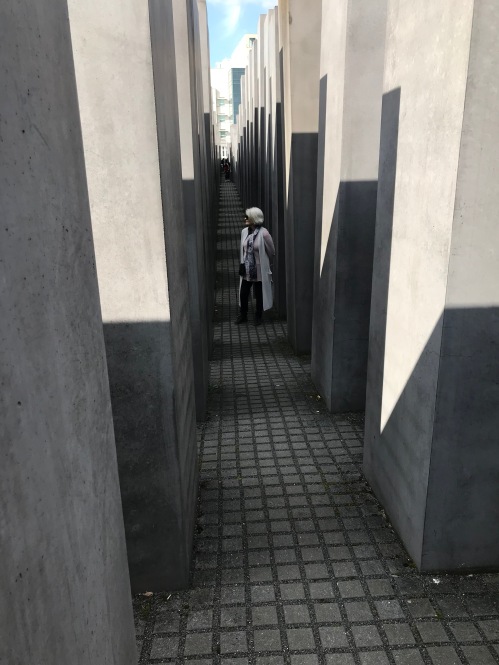
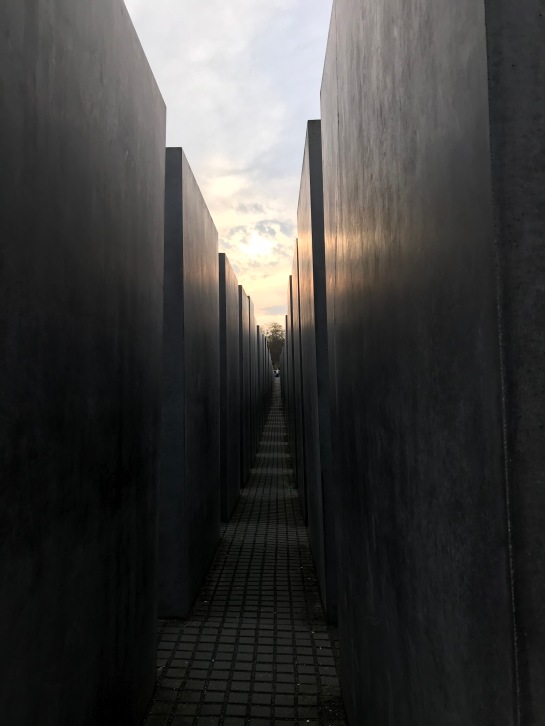
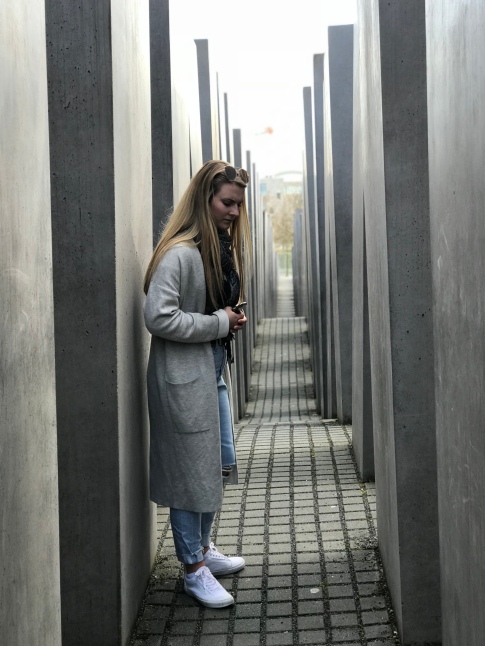
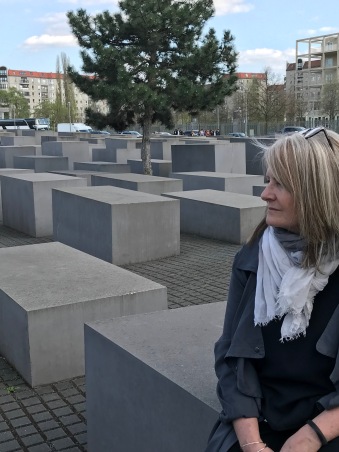
As I had deliberately not done any research prior to my visit, the initial impact of the memorial was both sombre and visceral. Located centrally in Berlin near the Brandenburger Tor and the Tiergarten, on a large block, the site is covered by over 2700 concrete slabs ( stelae) in a grid pattern.


The stelae are each almost 8 by 3 feet and vary in height. In rows with enough room for a person to walk between them they are laid out on the rising and falling ground. Were they meant to be coffins, a cemetery? As we walked along the alleyways between the stelae we would disappear as the ground dipped or as we turned a corner, or changed direction. Eerie, grave, sobering, my mind was filled with thoughts of how Jewish families disappeared, gone–removed from the streets of Europe. 6 million Jews. The sun would appear and disappear….light, dark, light, dark. It was confusing, troubling, and overwhelmingly isolating.

The installation was designed by Peter Eisenman. While he said that the memorial has no specific meaning, that it represents a radical approach, leaving room for personal interpretation, my friends and I experienced similar feelings. Wolfgang Thiers a President of Germany’s parliament described the piece as a place where people can grasp ‘what loneliness, powerless and despair mean’.
fullsizeoutput_8fa2


wWnRAJmcR5WvwpKGqnVOPQ

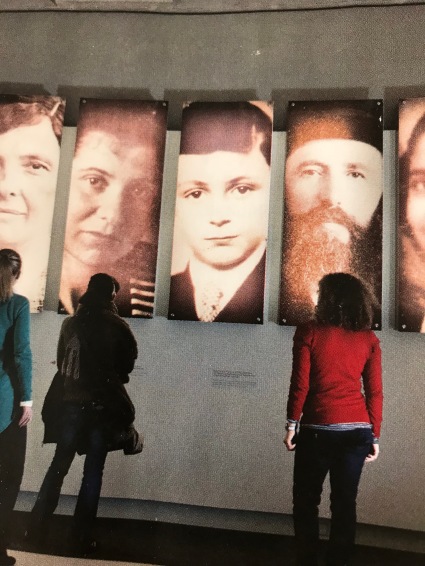
At one end of the site is the information centre.  The exhibition is remarkable! Incredibly moving and superbly curated. Through a series of rooms you discover the timeline and history of the Final Solution, you are given insights on how Hitler’s policies impacted 15 specific Jewish families, you hear read out load the names of the victims in the Room of Names, and you are introduced to the scale and terror of the death camps. The rooms were a deep contrast to the stellae site above. One did not need to imagine. Visual reminders, pictures, documents, letters, postcards, testimony and recorded memory of survivors. It is real, detailed, close and very personal. Each of the four room tells the story in a very concise and deliberate way.
O2TReM1CTi6Lrya+ONMEEA

It was hard to find words to describe our experience when we left the memorial.


As days have passed and I have reflected and researched, I think if you had time for only one thing in Berlin, visit this memorial.

It honours the Jewish people.

It speaks to how Germany has wrestled with its schwer history.

It prompts discussion and reflection on how we govern and are governed.

It is timely. It is what we need as a reminder of the outcomes of hate and prejudice.
qPKT5uXkQDyUAYfFiI3hug


fullsizeoutput_8ed5


One of the most significant and impactful events experienced by Berliners was die Berliner Mauer The Berlin Wall. The wall is not a distant memory. It is visible and powerfully striking.

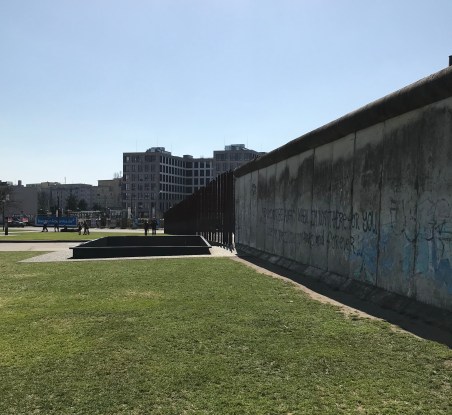
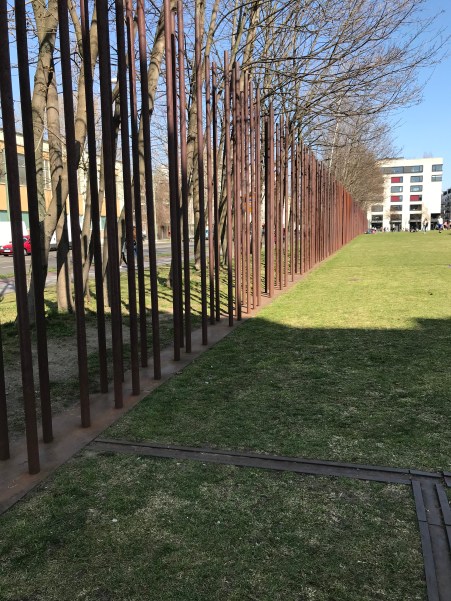
On my first day traveling from the main Berlin train station to my apartment, the journey took me via Bernauer Strasse. I noticed columns of narrow iron posts and what appeared to be green walking paths. I knew almost immediately I was experiencing traces of the Berlin Wall. I knew this would be a path I would spend time to explore.

8ARm6uKWQqCDTk1pNMTxEg


The Berlin Wall appeared overnight on August 13 1961. Berliners woke up to 23 miles of barbed wire strung through Berlin, separating East from West Berlin. Within two weeks a concrete block wall emerged. Overtime additional obstacles continued to be added. In my second post on the wall I will provide a more detailed physical description of the ‘wall’.

It was the most concrete and enduring symbol of the Cold War.

Die Berliner Mauer has its origins in the outcomes of the Potsdam Peace Conference. The victorious Allied forces determined that Germany’s territories should be split into four ‘allied occupation zones’. The Eastern part of Germany went to the Soviet Union and the Western parts to the US, Great Britain and France. Berlin was centrally located in East Germany.

As Berlin was the capital and home to the defeated Hitler, it had particular significance to the allied powers and so it too was divided into 4 sectors,(Soviet, US, British and French) even though the city itself was well into Soviet controlled East Germany. The four way occupation began in 1945.

TyxNnpH2RciA4Jp3YotfPA


With hindsight we might ask “ what were they thinking?” Tensions between the allied forces had existed even during the final days of the war. In the ensuing years tensions continued. Over time West Berlin had become a conspicuously capitalist city deep within communist East Germany. In the years following the formation of East and West Germany, a seemingly endless flow or refuges ( millions, many of them young skilled professions ) moved from the eastern communist sector, the GDR, officially known as the German Democratic Republic  to west Germany  the  Federal Republic of Germany.

 By the 1960s the waves of defections were an embarrassment and economically damaging. Many were existing through Berlin.  In June 1961, some 19,00 people left the GDR through Berlin. In July 30,000 followed. On the 12th of August, 2,400 left– the largest number ever to leave on a single day. On August 13th The GDR erected Die Berliner Mauer.

The wall stood for 28 years until November 9, 1989.

Before the wall was built Berliners on both sides of the city could move freely from east to west. They crossed to work, shop, go to school, church, the theatre and movies. Trains, trams and subway lines passed back and forth across the border. Once the wall was built, it became impossible to get from East to West Berlin except through three checkpoints. Checkpoint Alpha, Checkpoint Brava and Checkpoint Charlie. Travelers were screened by East German soldiers on the east and US, British or French soldiers on the West. Citizens of East Germany were not allowed to travel to West Berlin.

My first experience with the Berlin Wall came when I was 21. I was studying in Munich. The West German government provided an all-expenses paid weekend in Berlin for students from Canada and America. Clearly, they did not want the west to forget the challenges in Germany and particularly Berlin. We crossed over into East Berlin through Checkpoint Charlie. While I don’t have as vivid a recollection as I would like, I recall that East Berlin (now under communist rule for over 25 years) was bleak and stark. There were big empty spaces Signs of the war bombings were still very much in existence—it was clearly a city that continued to need to rebuild. The city did not feel whole. The subway had stops that were boarded up and you could not exit as they were in East Berlin.

On our second day into East Berlin, we happened to come upon a group of young east Berlin students. Well perhaps given we were mostly female and they were a group of young men, maybe not so surprising. They were eager to show us places in East Berlin not on the tourist track. We went further into East Berlin to their neighborhood. They spoke of being constantly watched, having to take care in engaging with us.  And indeed, some of the slanted glances we got from others  on the buses as we traveled were uncomfortable. Our dress (expressive of our ‘west’ culture) certainly made us clearly outsiders. It was an unnerving experience. To this day the memories of that experience suggests to me what it is like to be restricted and how lucky I have been to live where I am free.

Today there is still a lasting imprint of the wall—physically and emotionally.

Berliners continue to commemorate the wall. The wall was 96 miles long, 23 of those miles cut through the neighborhoods in the central of Berlin.

4jcFFFpZT2CnUC+ouEb6IQ

To the east, along the river Spree, which flows through the centre of Berlin, you will find the East Side Gallery. It consists of a series of murals painted on a 1316 Metre long remnant of the Berlin Wall. It is a heritage protected landmark, a monument to the fall of the Berlin Wall. It consists of 105 paintings by artists from all over the world. It was created in 1990 and due to weather and graffiti forces has had to be restored at times. The murals express hopes for a better freer, greener world for all peoples. I have included some of the photos I took as pictures can do so much more than words.


+UCZA8ygQPW7Kv8tILxmTg

To the west is Die Gedenkstatte Berliner Mauer, The Berlin Wall Memorial.  This is what I came upon that first day in Berlin. There is much to relay about the memorial. It gives insight into how the wall affected the city, the Berliners who lived here, those who lost their lives and those who survived and finally how the wall fell.  I will try to capture the impressions of this section of the wall in a subsequent post.

nL0+TZMZTLWTz9SxQHiE0A

fullsizeoutput_8ecc

The wonderful weather in my first week, has led me to seek out points of interest with lots of green space and the opportunity to enjoy the sun and warmth.

It was therefore no surprise that I found myself on the U-bahn to the neighborhood or kieze of Charlottenburg.

First a few words about Berlin neighborhoods or kiezes. Officially Berlin consists of 12 boroughs, which are divided up into a total of 96 districts. But in reality Berliners don’t live in boroughs or districts they live in their kieze-a neighborhood which may be defined by geography but more typically a feeling, a sense of belonging. I have only been here about a week and already feel that my kieze of Pretzlauerberg Is my ‘hood’.

Soon after arriving, I discovered a great app called Going Local Berlin. It’s objective is to help you experience Berlin and explore the 12 boroughs like a local. It has more than 600 tips on what to see, do and experience -markets, cafes, boutiques, events, parks all organised by kieze. I have found it to be incredibly helpful wherever I am in Berlin. I simply look up that kieze and have at my finger tips lots of local options. It so much better than the typical tourist info.. so if you come to berlin, use this app.
https://itunes.apple.com/ca/app/going-local-berlin/id964438630?mt=8

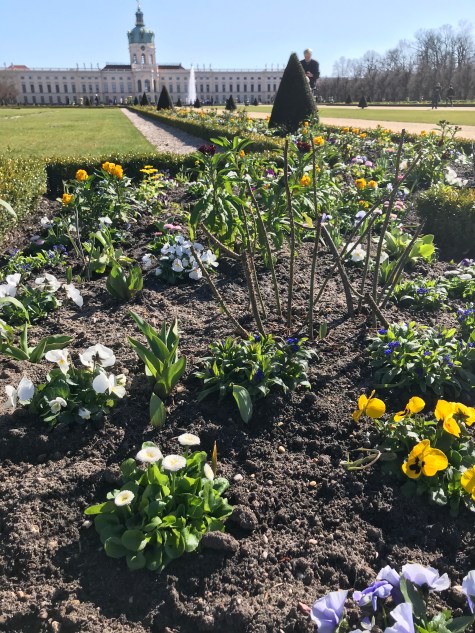
So, earlier this week on a glorious spring morning I made my way to Charlottenburg Palace. The palace, the largest surviving royal place in Berlin, is in an affluent kieze, Charlottenburg-Wimersdorf. It is named after Sophia Charlotte of Hanover wife of Elector Frederick III of Brandenburg and sister of the English King George I. It was built by the architect Johann Arnold Nering in the 1690s. It was enhanced after Frederick crowned himself Frederick I, first King of Prussia. Clearly, the new King and Queen needed to have larger gilded rooms given their new status.

The palace was extensively bombed during the second world war and bit by bit is being restored. Many of the interior furnishings were destroyed, but I still found it a worthwhile visit. Queen Charlotte collected porcelain, consequently both the palace and the former garden Belvedere Tea House have beautiful porcelain displays

The gardens are huge and have seen many changes as various rulers landscaped in accordance with the sentiments of the times. Even though it was an early april spring morning, the main gardens had already been planted. I can only imagine how lovely these gardens are in full summer.

9w7+rUviRY+VZHbrytRPRgj8sbIsKHQteDPrQWNs8+yA

There is a beautiful boulevard, Schlossstrasse, that runs for several blocks to take you to the castle. Beautiful old homes and buildings line the street, and in the middle lovely green walking space. People play bacci and sit on the benches taking in the sun. As I neared the palace I came across an outdoor photo exhibit. Gegen das Vergessen

For two blocks screens, large 10 by 8 canvases of photos of faces. Old faces, men and women, wrinkled, some smile, some don’t. On some you see blue and white striped hats. It doesn’t take long to figure out I am again experiencing the schwer in Berlin. The portraits are striking, you see the whiskers on the old faces both men and women, smeared eyeliner, some women with jewels and scarves others starkly simple. They speak for themselves. While different, all share a common history-they survived the holocaust.

It is a moving installation! Walking along. I read many of the short histories of those portrayed. Their current age, where they now live, where they lived before the war, where they were incarcerated, who freed them.

On my return home, I researched the work. A “Mannheim artist Luigi Toscano has searched and portrayed Jews who have escaped Nazi persecution in five countries. The result is the photo installation “Against Oblivion”, in which the touching faces speak for themselves and their history.”