Archive

Germany

6H%n3YZrRJi+xkdV8Qi4eQ


In my initial blog on Berlin I shared that it was impossible not to be confronted by the schwer . The dark and problematic legacy of Hitler and the Nazis. Nowhere is this more in evidence than in two remarkable sites that I visited during my stay. The Memorial to the Murdered Jews of Europe and the Typography of Terror. This blog will deal with the first Die Denkmal für die Ermordenten Junden Europas.

Prior to visiting the site, I was already struck by the language describing the Memorial…..Murdered. The strength, censorious and exactness of the word. Not killed, not dead, murdered.

The language deliberately chosen by the German government. Appropriate and difficult.

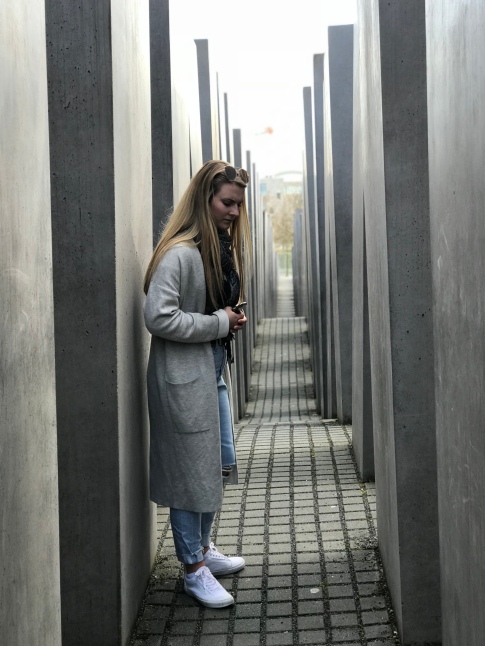
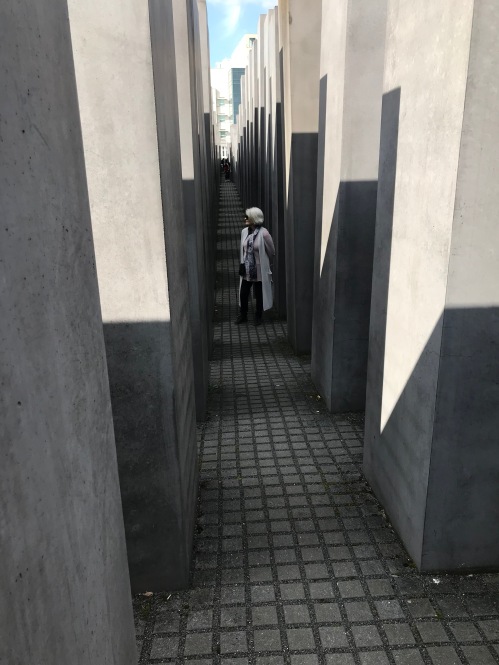
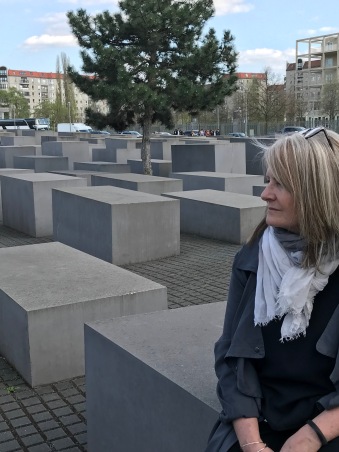
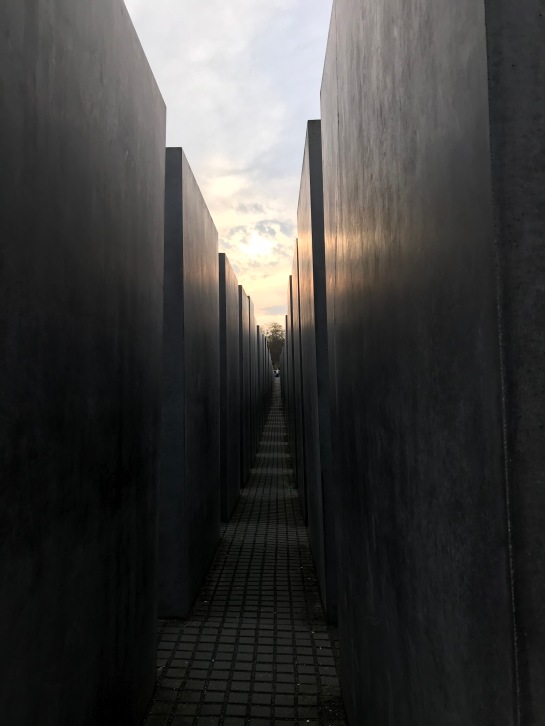
As I had deliberately not done any research prior to my visit, the initial impact of the memorial was both sombre and visceral. Located centrally in Berlin near the Brandenburger Tor and the Tiergarten, on a large block, the site is covered by over 2700 concrete slabs ( stelae) in a grid pattern.


The stelae are each almost 8 by 3 feet and vary in height. In rows with enough room for a person to walk between them they are laid out on the rising and falling ground. Were they meant to be coffins, a cemetery? As we walked along the alleyways between the stelae we would disappear as the ground dipped or as we turned a corner, or changed direction. Eerie, grave, sobering, my mind was filled with thoughts of how Jewish families disappeared, gone–removed from the streets of Europe. 6 million Jews. The sun would appear and disappear….light, dark, light, dark. It was confusing, troubling, and overwhelmingly isolating.

The installation was designed by Peter Eisenman. While he said that the memorial has no specific meaning, that it represents a radical approach, leaving room for personal interpretation, my friends and I experienced similar feelings. Wolfgang Thiers a President of Germany’s parliament described the piece as a place where people can grasp ‘what loneliness, powerless and despair mean’.

fullsizeoutput_8fa2


wWnRAJmcR5WvwpKGqnVOPQ

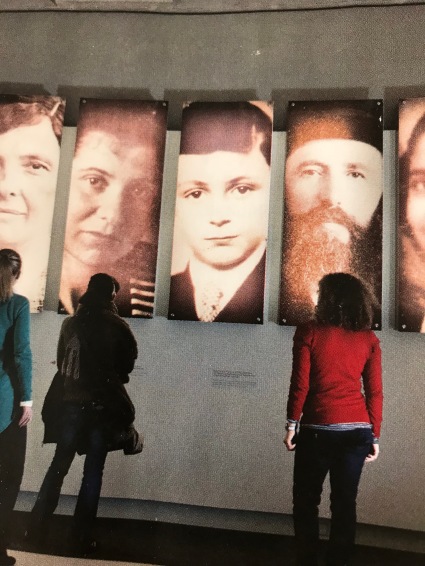
At one end of the site is the information centre.  The exhibition is remarkable! Incredibly moving and superbly curated. Through a series of rooms you discover the timeline and history of the Final Solution, you are given insights on how Hitler’s policies impacted 15 specific Jewish families, you hear read out load the names of the victims in the Room of Names, and you are introduced to the scale and terror of the death camps. The rooms were a deep contrast to the stellae site above. One did not need to imagine. Visual reminders, pictures, documents, letters, postcards, testimony and recorded memory of survivors. It is real, detailed, close and very personal. Each of the four room tells the story in a very concise and deliberate way.

O2TReM1CTi6Lrya+ONMEEA

It was hard to find words to describe our experience when we left the memorial.


As days have passed and I have reflected and researched, I think if you had time for only one thing in Berlin, visit this memorial.

It honours the Jewish people.

It speaks to how Germany has wrestled with its schwer history.

It prompts discussion and reflection on how we govern and are governed.

It is timely. It is what we need as a reminder of the outcomes of hate and prejudice.

qPKT5uXkQDyUAYfFiI3hug


E2ZKkKbARsyXJ7evUAksXg

The Memorial to the Berlin Wall is situated in the western part of Berlin. While the centrally located Checkpoint Charlie has become a kitschy over the top tourist site, the Memorial has been thoughtfully designed and delivered.

My first view of the Berlin Wall Memorial occurred on my first day in Berlin as I was taxiing to my Airbnb apartment. I noticed an interesting wall of tall steel posts that stretched along the road. Almost immediately I sensed I was looking at the former wall. This section of the wall is very close to my apartment and so the next day I took a walk.

While there are two buildings to visit if you wish (the Visitor Centrum and the Berlin Wall documentation Centre), I found the best way to experience the Memorial is to simply walk the exhibit. It stretches for about 8 blocks.

As you walk the wall you see that ‘die Berliner Mauer’ cut right through a living, breathing neighborhood.

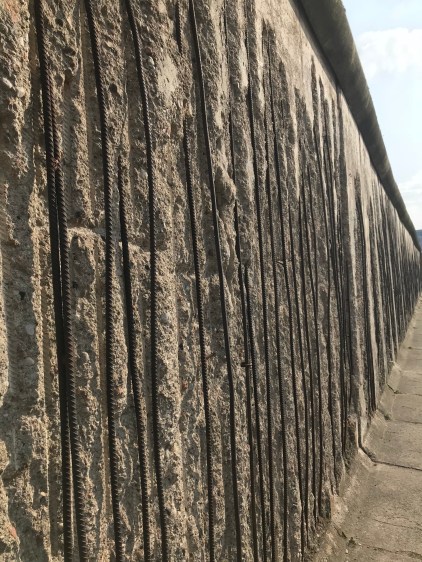
The installation is a very thoughtful and thorough representation of the wall, its physical, emotional and psychic impact on a divided Berlin. The line of steel posts as well as a surviving intact portion of the ‘wall system’ deliver a punch as you consider how it divided a former neighborhood.

As you walk the wall path, you find other posts—they contain photos, written documents, and recordings which provide actual stories of those who lived in the area during the 60s-80s, how the wall was built, how the wall fell, the timeline and details of the ‘wall system’, the attempted escapes over the wall as well us through underground tunnels.

3sUIf4n9SIu5Pjs6HX5jow

The Window of Remembrance monument presents those who lost their lives in attempting to escape from East Berlin. The black and white photos, the dates of their birth and the date of their deaths at the wall hit hard. While there I found a picture of a young man Werner Kuhl ( the one on the left below), born within a year of my birth, who attempted to escape the year that I visited in 1971.  Hard to grasp that the wall took his future.

fullsizeoutput_9092

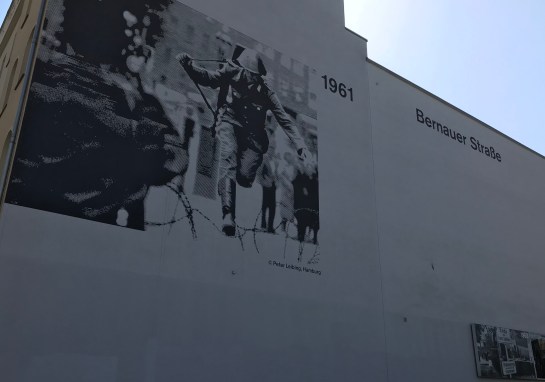
The first defector to escape across the Berlin Wall was 19-year-old East German border guard Corporal Conrad Schumann, who was immortalized on film as he leapt over a 3-foot-high roll of barbed wire just two days after East Germany sealed the border. At that time, a simple roll of barbed wire had been erected..he simply pushed a portion down each time he walked that part of the border on his patrol walk. Signaling to the West German police his intentions, who called the press, he eventually jumped and made his escape.
fullsizeoutput_9093

His photo is memorialized on the wall of the building along the ‘mauer’ walk.

Over time considerable additional barriers were erected by East Berlin border patrol to stop the flow of East Berliners fleeing to the West.  Eventually, s 12-foot-tall, 4-foot-wide mass of reinforced concrete was topped with an enormous pipe that made climbing over nearly impossible.

ry4fg9KhSKml5nH0szc4Rw

Behind the wall on the East German side was a so-called “Death Strip”: a gauntlet of soft sand (to show footprints), floodlights, vicious guard dogs, trip-wire machine guns, anti-vehicle trenches and patrolling soldiers with orders to shoot escapees on sight. The Mauer Walk provides a real insight into the size of the strip and difficulties it presented to escapees.
0u04vuzFTtatu5TSxNlaggGyVs2LLQT0er2qN7IwBXig

At least 138 people died trying to cross the border. While some did make it safely across, it is unclear how many people exactly reached the western part. Some estimates claim that 5,000 East Germans reached West Berlin. Many of these occurred early on in the mass escapes.

The first victim was Ida Siekmann, who died on August 22, 1961, after attempting to leap to a West Berlin street below her fourth-floor East Berlin apartment window.  Others who did leap out of buildings were caught by West Berlin fireman. The last fatality occurred in March 1989 when a young East German attempting to fly over the wall in a hot air balloon crashed into power lines.

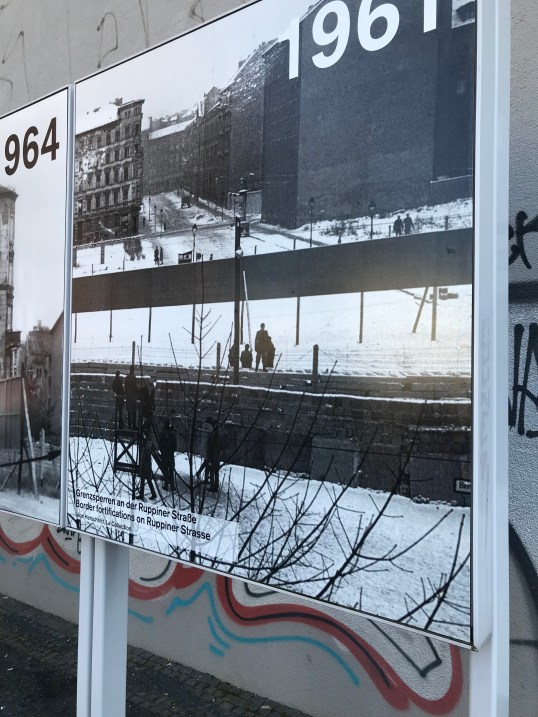
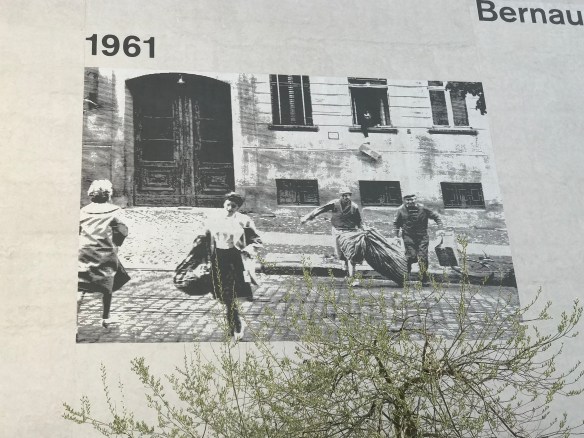
Large photos of escapees, the former wall and the neighborhood on the side of building walls along the path provide a clear depiction of various stages of life during the 28 years the wall separated Berlin.

The picture above on the right, really impacted me. You can clearly  see a mother standing on a chair, holding up her daughter…perhaps you can’t see it but far off in the distance on the right side is an old woman, mother of the woman and granddaughter to the child, waving back. Families separated by a wall and the ‘death strip’. Pictures on the left show other West Berliners, standing on ladders waving to friends and family.

One of the most impactful memorials, deals with the effect of the wall on those who lived on  Bernauer Strasse. This street, the heart of an urban space, was cut in half by die Berliner Mauer. It separated families, friends, and people from their local shops. On the morning of August 13 1961, neighbors awoke to a barbed wire fence running through their kieze, and many were cut off from streets they always traveled. On Bernauer Strasse the border ran directly in front of their homes. Residents in these buildings initially walked out their front doors to freedom, and after the eastern guards evicted the first floor residents, they jumped out of the 2nd and 3rd stories—some seriously injuring themselves—the first ‘wall’ fatalities occurred here. Overtime, all the residents on the east of the border were evicted, all windows and doors bricked up and eventually they were destroyed . The East Berliners in this area continued their resistance and attempts to escape… they built escape tunnels, they scaled the walls and ran the ‘death strip’. This neighborhood conveyed the lack of alignment between the population and the East German leadership.

In the picture on the left the path of the escape tunnel 57, named for the 57 people who escaped through it. I was surprised at the number of tunnels built yet the lack of success in making this a real way of escape.

The picture on the right shows the foundation of one of the Bernauer Strasse houses that were destroyed after its owners were evicted. The green space beyond had been a row of apartment blocks housing businesses and families.

Not surprisingly, on the night of November 9 ,1989, the first segments of the ‘wall’ were knocked down by the citizens at the crossing between Bernauer and Eberswalder Strasse, creating the first free crossing between East and West Berlin. On that night the head of the East German Communist Party declared that East German citizens could cross the border whenever they pleased. It was expected that an orderly bureaucratic approach to the new access would be developed. This did not happen. On hearing the news, ecstatic crowds swarmed the wall, crossing the borders, taking picks and hammers to the wall. I expect many of those reading this blog may well remember the pictures of the triumphant crowds on the wall in front of the Brandenburger Tor. Over that following weekend more than 2 million people crossed the borders, visiting family, friends and neighborhoods they had not seen for 28 years. Berlin was one awesome street party, united for the first time since 1945!!!

One year later the reunification of East and West Germany occurred. On October 3, 1990 Germany finally became one country again.

fullsizeoutput_8ecc

The wonderful weather in my first week, has led me to seek out points of interest with lots of green space and the opportunity to enjoy the sun and warmth.

It was therefore no surprise that I found myself on the U-bahn to the neighborhood or kieze of Charlottenburg.

First a few words about Berlin neighborhoods or kiezes. Officially Berlin consists of 12 boroughs, which are divided up into a total of 96 districts. But in reality Berliners don’t live in boroughs or districts they live in their kieze-a neighborhood which may be defined by geography but more typically a feeling, a sense of belonging. I have only been here about a week and already feel that my kieze of Pretzlauerberg Is my ‘hood’.

Soon after arriving, I discovered a great app called Going Local Berlin. It’s objective is to help you experience Berlin and explore the 12 boroughs like a local. It has more than 600 tips on what to see, do and experience -markets, cafes, boutiques, events, parks all organised by kieze. I have found it to be incredibly helpful wherever I am in Berlin. I simply look up that kieze and have at my finger tips lots of local options. It so much better than the typical tourist info.. so if you come to berlin, use this app.
https://itunes.apple.com/ca/app/going-local-berlin/id964438630?mt=8

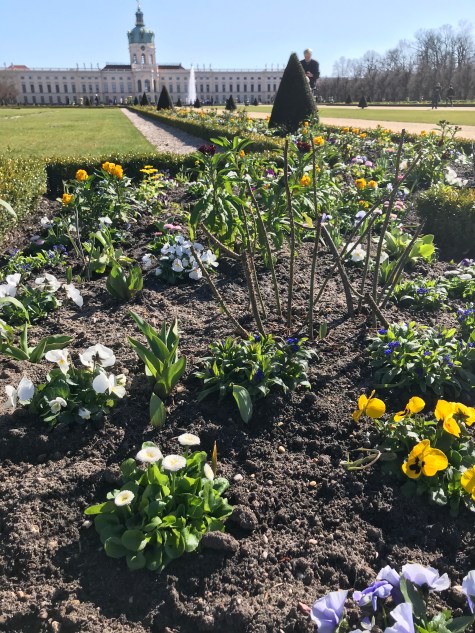
So, earlier this week on a glorious spring morning I made my way to Charlottenburg Palace. The palace, the largest surviving royal place in Berlin, is in an affluent kieze, Charlottenburg-Wimersdorf. It is named after Sophia Charlotte of Hanover wife of Elector Frederick III of Brandenburg and sister of the English King George I. It was built by the architect Johann Arnold Nering in the 1690s. It was enhanced after Frederick crowned himself Frederick I, first King of Prussia. Clearly, the new King and Queen needed to have larger gilded rooms given their new status.

The palace was extensively bombed during the second world war and bit by bit is being restored. Many of the interior furnishings were destroyed, but I still found it a worthwhile visit. Queen Charlotte collected porcelain, consequently both the palace and the former garden Belvedere Tea House have beautiful porcelain displays

The gardens are huge and have seen many changes as various rulers landscaped in accordance with the sentiments of the times. Even though it was an early april spring morning, the main gardens had already been planted. I can only imagine how lovely these gardens are in full summer.

9w7+rUviRY+VZHbrytRPRgj8sbIsKHQteDPrQWNs8+yA

There is a beautiful boulevard, Schlossstrasse, that runs for several blocks to take you to the castle. Beautiful old homes and buildings line the street, and in the middle lovely green walking space. People play bacci and sit on the benches taking in the sun. As I neared the palace I came across an outdoor photo exhibit. Gegen das Vergessen

For two blocks screens, large 10 by 8 canvases of photos of faces. Old faces, men and women, wrinkled, some smile, some don’t. On some you see blue and white striped hats. It doesn’t take long to figure out I am again experiencing the schwer in Berlin. The portraits are striking, you see the whiskers on the old faces both men and women, smeared eyeliner, some women with jewels and scarves others starkly simple. They speak for themselves. While different, all share a common history-they survived the holocaust.

It is a moving installation! Walking along. I read many of the short histories of those portrayed. Their current age, where they now live, where they lived before the war, where they were incarcerated, who freed them.

On my return home, I researched the work. A “Mannheim artist Luigi Toscano has searched and portrayed Jews who have escaped Nazi persecution in five countries. The result is the photo installation “Against Oblivion”, in which the touching faces speak for themselves and their history.”


vgfJHWmvS2qdgu+WXyOQog

I am about to complete my first week in Berlin.
Berlin is at the same time appealing, fascinating and confusing. Although I will remain here for a full month, I anticipate I will  not ,in this time, be able to fully grasp all its features, or to come to grips with what is essentially so Berlin.

Last night I attended Mozart’s Die Zauberflote, The Magic Flute. It was a beautiful warm evening and I was seated outside watching all the opera goers entering in their finery ( delightfully, people dress for Opera). I was joined by an older woman, ein Berliner, also waiting for her companions before entering. I was commenting on the beauty before us as we sat in the sun looking down Unter den Linden. She had learned that I had studied modern European history in Munich over 40 years ago. She smiled and sighed simultaneously and said yes we have such history, much of it beautiful and so much of it schwer. Schwer, meaning heavy and burdensome. Perhaps this conversation best describes my frames of Berlin to this point. I have found much of it beautiful and delightful. But it is impossible not to be confronted by the schwer wherever I go. I anticipate as I describe my first week, you will find these frames set side by side, juxtaposed.
Berlin, vibrant, current, livable. Die Mauer, remnants of a divided city. Berlin, Hitler’s capital, schwer, a dark history, destruction and reconstruction. Berlin home to art and culture.

So to begin.

I have a lovely apartment in Pretzlauer Berg. It is in a five story structure built in an inner courtyard off Hagenauer Strasse. Delightfully my charming Airbnb apartment is on the main floor and I have the enjoyment of my own private garden, where I currently sit typing my blog. Mercedeh Sanati of Quench Trip Design is my go to guide of where to go and stay. She directed me to find an apartment in the trendy cool district of Pretzlauer Berg. Situated in what was formerly East Berlin, it was largely untouched by the IIWW, but its classic old apartment blocks, factories and brauerei deteriorated under communist rule. Today it has seen a typical urban revival as professionals with young families abound along with bars and cafes. My first walk in my new ‘hood’ was a great delight…a warm beautiful evening strolling through an awakening Pretzlauer Berg. The first week of April and temperatures in the high teens and low 20s have me thoroughly enjoying the markets, parks, cafes and shops in this appealing neighborhood.

My guests will start to arrive in week two, so I always try to get a feel for the city I will call home for a month in my first few days. While I keep telling myself I should do the Hop On Hop Off tours to get a perspective on the city, I always find myself simply walking to where I want to go or taking the transit ( which is very good in Berlin–great tram, bus and subway service) to another neighborhood I want to explore. In this first week I have logged almost 60 kms walking the streets and allees of Berlin. Bretzlauer Berg is centrally located so possible to actually walk to many of the destinations I have on my list.

In my first day I walked to the centre in about 45 minutes. Large open spaces still hint at the devastation caused by the bombing of Berlin, but cranes and construction everywhere give testament to a city that is still in the reconstruction process.

Architecturally it is a confusing city. So much of Berlin was bombed or demolished following the war to be rebuilt by differing east/west visions and needs and subsequently by reunification realities.

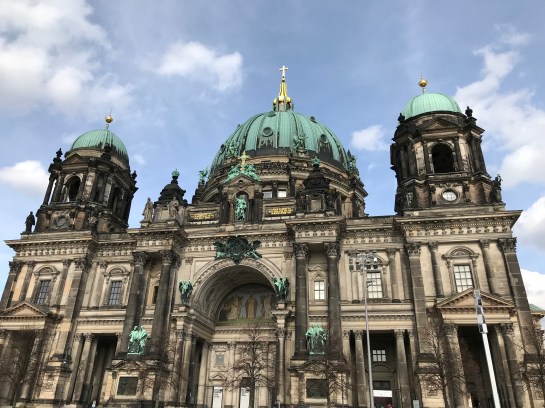
The famous grand boulevard Unter den Linden continues its appeal. It was established in the 15th century as a carriage way from the Berlin Palace to the Prussian Royal Families hunting ground ( today the Tiergarten Park). The Berlin Palace is currently being rebuilt on the Museum Insel. The Palace was demolished by the East German government following the war. Today’s rebuild is apparently also controversial as the city of Berlin decided to knock down the Palast der Republik, the East German parliament to make way for it. The StaatsOper  ( the Opera House) was also destroyed twice  by bombs during the second world war.

Rebuilt once during the war and then again afterwards, it has recently reopened following a full renovation to bring it up to date for today’s opera acoustic needs.

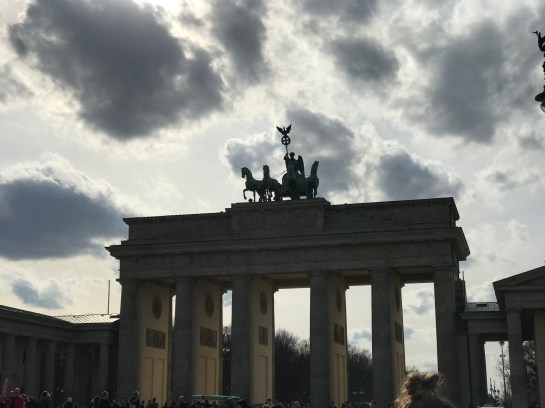
Unter Den Linden was named for its thousand linden trees ( lime trees). Beloved by Germans, when Hitler cut many of them down to make way for his Nazi flags, discontent forced him to replace some of them. In the last days of the war, most of the trees were cut down for firewood. Luckily, they were replanted in 1950. The street was situated in East Berlin post war. Museum Insel which houses many of the cities museums, Berlin’s Humboldt university and the Opera house grace this beautiful boulevard which ends at the historical Brandenburg gate.

Tvp0f+I3SamBI7ub6g65cQ

The East West Berlin wall ran alongside the Brandenburg gate. Prior to the building of the wall, many west berliners regularly visited the cultural sites along the Unter den Linden.

A former guardhouse, the Neue Wache, has become a universal memorial to the victims of war and tyranny. In

Indeed as I reflect on my walks down Unter den Linden and recall my conversation with die alte Berliner, Berlin is beautiful and schwer.