

The wonderful weather in my first week, has led me to seek out points of interest with lots of green space and the opportunity to enjoy the sun and warmth.
It was therefore no surprise that I found myself on the U-bahn to the neighborhood or kieze of Charlottenburg.
First a few words about Berlin neighborhoods or kiezes. Officially Berlin consists of 12 boroughs, which are divided up into a total of 96 districts. But in reality Berliners don’t live in boroughs or districts they live in their kieze-a neighborhood which may be defined by geography but more typically a feeling, a sense of belonging. I have only been here about a week and already feel that my kieze of Pretzlauerberg Is my ‘hood’.
Soon after arriving, I discovered a great app called Going Local Berlin. It’s objective is to help you experience Berlin and explore the 12 boroughs like a local. It has more than 600 tips on what to see, do and experience -markets, cafes, boutiques, events, parks all organised by kieze. I have found it to be incredibly helpful wherever I am in Berlin. I simply look up that kieze and have at my finger tips lots of local options. It so much better than the typical tourist info.. so if you come to berlin, use this app.
https://itunes.apple.com/ca/app/going-local-berlin/id964438630?mt=8
So, earlier this week on a glorious spring morning I made my way to Charlottenburg Palace. The palace, the largest surviving royal place in Berlin, is in an affluent kieze, Charlottenburg-Wimersdorf. It is named after Sophia Charlotte of Hanover wife of Elector Frederick III of Brandenburg and sister of the English King George I. It was built by the architect Johann Arnold Nering in the 1690s. It was enhanced after Frederick crowned himself Frederick I, first King of Prussia. Clearly, the new King and Queen needed to have larger gilded rooms given their new status.


The palace was extensively bombed during the second world war and bit by bit is being restored. Many of the interior furnishings were destroyed, but I still found it a worthwhile visit. Queen Charlotte collected porcelain, consequently both the palace and the former garden Belvedere Tea House have beautiful porcelain displays


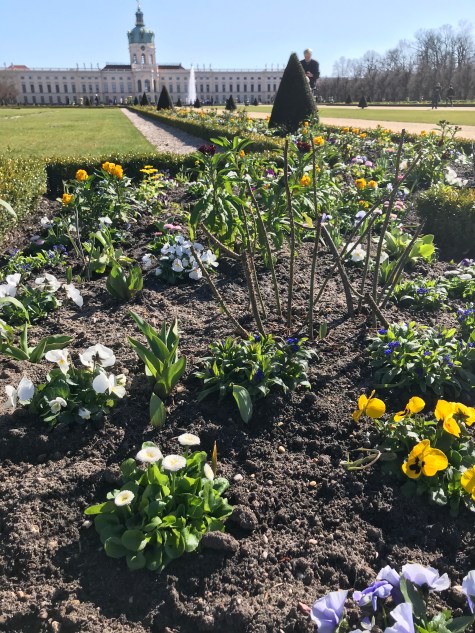
The gardens are huge and have seen many changes as various rulers landscaped in accordance with the sentiments of the times. Even though it was an early april spring morning, the main gardens had already been planted. I can only imagine how lovely these gardens are in full summer.


There is a beautiful boulevard, Schlossstrasse, that runs for several blocks to take you to the castle. Beautiful old homes and buildings line the street, and in the middle lovely green walking space. People play bacci and sit on the benches taking in the sun. As I neared the palace I came across an outdoor photo exhibit. Gegen das Vergessen
For two blocks screens, large 10 by 8 canvases of photos of faces. Old faces, men and women, wrinkled, some smile, some don’t. On some you see blue and white striped hats. It doesn’t take long to figure out I am again experiencing the schwer in Berlin. The portraits are striking, you see the whiskers on the old faces both men and women, smeared eyeliner, some women with jewels and scarves others starkly simple. They speak for themselves. While different, all share a common history-they survived the holocaust.


It is a moving installation! Walking along. I read many of the short histories of those portrayed. Their current age, where they now live, where they lived before the war, where they were incarcerated, who freed them.
On my return home, I researched the work. A “Mannheim artist Luigi Toscano has searched and portrayed Jews who have escaped Nazi persecution in five countries. The result is the photo installation “Against Oblivion”, in which the touching faces speak for themselves and their history.”


 gmarkvoort