
Cusco
In February of 2018, I joined my daughter Rachael for an extended holiday in South America visiting Argentina and Peru. This blog covers our memorable hiking trip in the Andes in the Cusco region located in the southern central part of Peru. Cusco, the city is the capital of the Cusco region. The Andes are the second highest mountain range after the Himalayas, its highest point is Mt Huarascan at 22,204 feet. I can’t imagine what the air must be like at that height…it was challenging enough managing to hike and breath at 12,000 feet.
Our hiking experience was arranged with Peru Ecocamps https://www.peruecocamp.com
As in the past, I leveraged the knowledge and experience of Mercedeh Sanati of Quench Trip Designs http://www.quenchtravel.com Mercedeh’s knowledge of south America ensured our adventure would be remarkable. Having advised her that we wanted to include a hiking challenge she quickly recommended PeruEcoCamps.
Our experience began in Cusco. The evening of our arrival at our boutique Tierra Viva Cusco Plaza Hotel https://tierravivahoteles.com/tierra-viva-cusco-plaza/ (we recommend), Johann Munoz our PeruEcoCamp tour guide met us to review the week ahead. Johann was born in Cusco and has worked as a mountain guide for many years. We would find out over the course of the week, that he was extremely knowledgeable, both about the culture and history of the area as well as thechallenges of the Andes mountains. It became clear that we would be in very good hands.
Chonta and the Condors
Early the next morning Johann and Jose our driver for the week, picked us up bright and early.
Our first stop was an Inca ruin. It was the beginning of our introduction to the indigenous culture of Peru. We were to learn much more over the course of the week with Johann


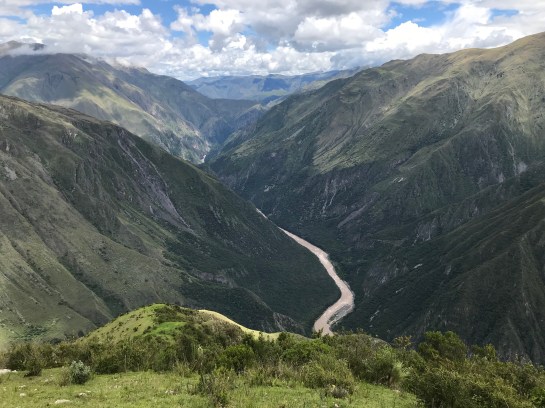
By mid-morning after a harrying ride up the mountain, we were on our first hike of the week starting at mountain hamlet of Chonta (11,000 feet) to discover the beauty of the Apurimac Canyon. Our trek was moderately difficult taking us to a lookout point over the canyon. Our hope and purpose were to catch sight of the majestic Andean Condor. The condors love the canyon as they soar upwards from the canyon floor on the thermal winds, reaching heights up to 26,000 feet. Reported to have a wingspan of 9-10 feet they are truly majestic birds—it is one of the largest birds in the world standing up to 4 feet high and weighing up to 27 pounds. It can fly for hours without using its wings, simply by gliding on the thermal winds In Andean lore, it is believed that the souls of the dead are transported to the spirit world on the wings of the condor.
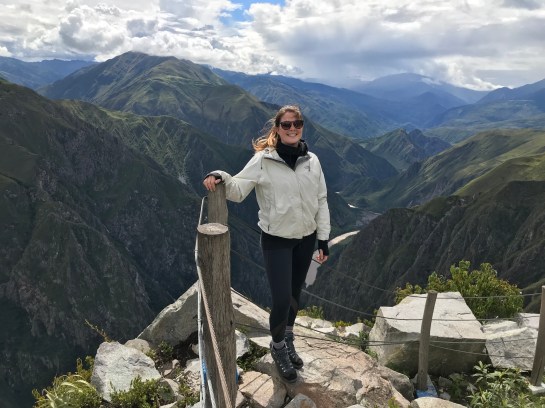
It was windy and chilly as we arrived at the lookout point and we tucked into our lunch keeping our eyes peeled to the sky and the canyon. After several hours and somewhat disappointed that we had not seen any birds, we started our hike back down the mountain. And then of course, we spotted the Condor. They are truly mesmerizing!! I managed to get a short video clip of them in the distant but was too caught up in the moment to record them in pictures. In the space of a about 20 minutes we managed to catch sight of 2.
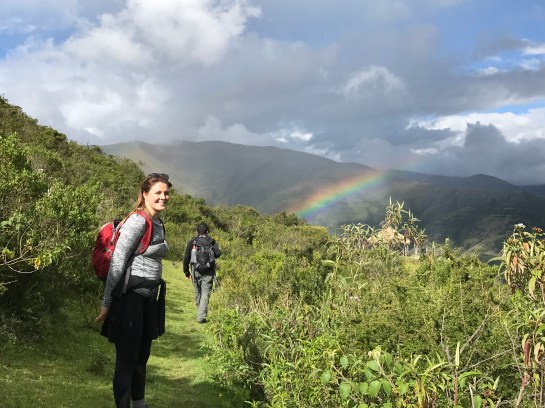
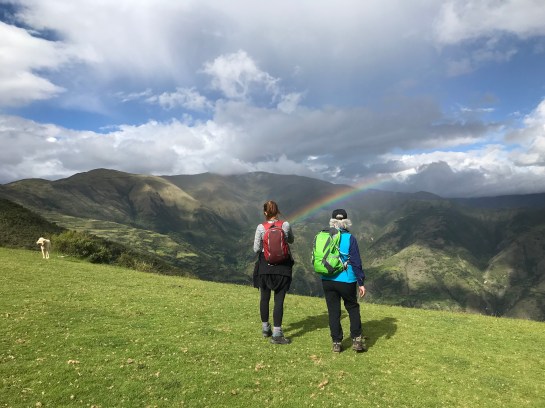
As we made our way enthusiastically down the mountain, we saw rain in the distance and then were awarded a gorgeous rainbow… this became a regular occurrence as we trekked in the Andes. Cloudy, sun, rain, cloud, rain, sun, rainbows!!! It made it all worthwhile.
From Chonta our driver took us via the town of Mollepata to our first Eco Camp Pincopata. Our first sighting of the ecodomes nestled in the hills thrilled us. On arrival we were greeted by the staff, a lovely tea and escorted to our domes
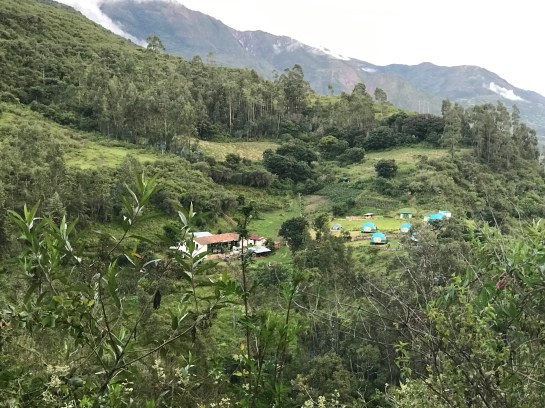
Home Sweet Dome:


The Peruecocamps promised to offer a luxurious camping experience…and glamping it was!!!
Beautifully appointed, comfortable beds with exceptional linens, full private bathrooms, and inviting wood burning stoves, we had dropped into the lap of luxury in the heart of the Andes Mountains. Gushing over our new accommodations, and after a lovely hot shower, we joined Johann in the ecodome dining room to enjoy a lovely dinner of local Andean food. The camps all have gardens and the kitchen uses local fresh produce from the gardens and local farmers. A lovely glass of wine for me and a Pisco Sour for Rachael and we ended our first day happy we had come across this adventure.


After a lovely breakfast the following morning, and a drive further northwest, we left our driver and car and started our second hike with Johann. The day threatened to be a wet one and we donned our new ponchos (bought in Cusco at Johann’s suggestion) and started our hike. While this hike was labelled as easy to moderate, I experienced it as moderate to difficult. By this time, I was beginning to understand the difference of a 4,000 ft difference in elevation. My hikes in the Canadian Rockies were probably all under 8,000 ft—below 8,000 ft there are no high-altitude effects. But at 11,000 to 14,000 ft—the territory we were now hiking in – altitude sickness symptoms kick in. I was experiencing much more difficulty in catching my breath and keeping a normal hiking pace. Truth be told, I was probably also much less fit and several years older than the last time I hiked in the Rockies—all of which was impacting my ability to climb. Rachael and Johann were clearly not struggling as much as I was. We hiked the morning and into the early afternoon, but were not able to complete the ridge walk which was to take us to our destination at the second camp. Nevertheless, it was an exhilarating day… a fair bit of rain as well, so several clothing changes before we headed back down the mountain to be collected by Jose.


We arrive wet and tired to our second camp Soray Ecocamp (12,693 feet). The accommodations at Soray were just as elegant and comfortable as Pincopata.


Although both Rachael and I felt the effects of the high altitude (difficulty breathing, light headedness, mild headaches and sleeping challenges) we did not suffer severe altitude sickness. Our guide was very mindful of our water consumption, pace and energy level so we attributed our wellness to his careful watch over us.
After a rest, we headed off again to hike down the valley towards the Salkantay Pass, hoping that it would be clear enough to catch a glimpse of the Salkantay glacier. I chose to photo the fauna and flora near a rushing stream and Johann and Rachael hiked upstream—regrettably the valley was socked in so no glacial vistas.


Humantay Glacial Lake
The next morning over breakfast we discussed our upcoming hike. As we were now above 12,000 feet and hiking up to just under 14,000 ft I was quite nervous about my ability to manage the hike. Johann, as ever attuned to moods and my nervousness had the solution. He had arranged with a local to have a horse and guide accompany us—meaning once I got into a challenging section of the hike, I could choose to ride.
Hiking nerves under control, we set off at 7 am. Johann wanted us to be at our destination, Humantay Lake at the foot of the Humantay glacier by 9:30 am. He indicated the hike to the lake was a popular destination and by 9 am hordes of people would be starting their climb. He wanted us to experience the glacial lake with no other hikers. I hiked until I could see the steep terrain ahead of us and as suggested I mounted the horse and had an awesome experience trail riding up the fairly steep mountain.


Once we crested the cut into the small valley at the base of the glacier we were charmed by the turquoise blue glacial lake.
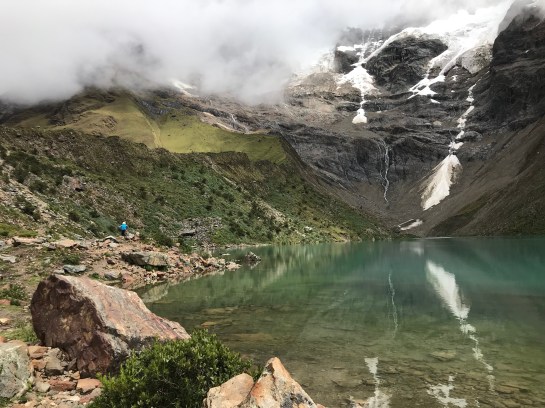
As promised by Johann we got to sit in total silence drinking in the beauty as the clouds circled the mountains giving us on again / off again views of the spectacular glacier at the far end of the lake.


At one point we saw two large black and white birds at the far end of the lake. Having spotted them Johann began one of his many narratives on the native wildlife and the Quechua people. The Quechua Indians of the Central Andes are the indigenous Andean population we mistakenly call the Incas. Johann told us that the Incas were not a people—the Inca was the name of the King. The Quechua existed in the Andes a century before the arrival of the Spanish. They were a highly civilised and developed nation (more to come on the Quechua people when I blog about Machu Picchu)
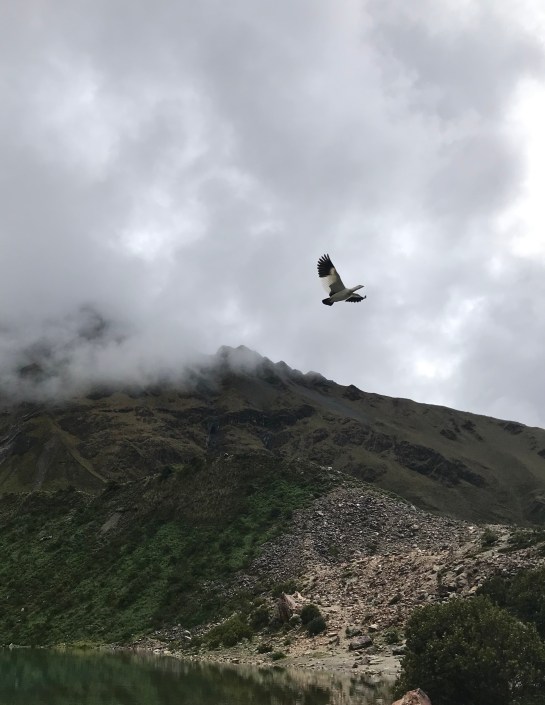
So back to the ‘bird tale’. As one of the birds soared over head, Johann reported that they mated for life and were found high in the Andes returning to their nesting grounds year after year. In his quiet telling the narrative looped into a story about how the Quechua people also mated for life. The choice of mate was an extremely important one … divorce did not exist… life was hard in the Andes and families were deeply involved in the selection process. The woman and man can choose their partner, and initially practice a trial marriage (this is still the case in the mountain regions of Peru today). During the trial period (lasting a year or more) the couple live together; the families check out the man or woman ensuring they are up to expectations—if all goes well the couple then get formally ‘married’ –but they have the choice to end the relationship during this trial period.
Throughout our time with Johann he would weave the stories of his people, the history of the culture, the fruits and ways of the land into our walking and dining experience—it was charming… a rock, a bird, an animal, a local, an entrée, a mountain or sunbeam would unlock another of his narrative sketches— by the end of our week with him, we had a whole canvas of legends, traditions and folk tales of the Andean culture, its food and its people.
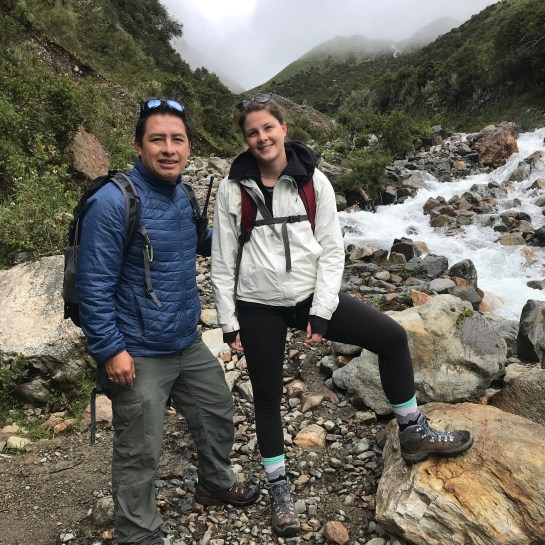
Johann our guide
Several hours later having returned to Soray Camp, dined on a lunch of local produce, Jose our driver took us back to our first camp Pincopata. We had hoped to take another short hike but the rains had washed out the road to the area. Johann and Jose took us on a rather interesting cultural trip.
Earlier in the week we had passed a small group of local Andean farmers standing at the side of the road having a break. The Quechua farmer in the high Andean communities starts his and her day at four in the morning. Most Quechua rely on subsistence farming for their livelihood. They hike up the mountains with their primitive wooden farm utensils to their farmland—terraces on the steep Andean slopes. We hardly ever saw animals or vehicles being used in their farm chores. Labour intensive their approach to farming was time consuming and tiring. By 10 am they were ready for a break. Johann informed us the morning break drink is chica,once a sacred drink of the Inca.
The Chica Bar


Given we could not hike, Johann and Jose decided to take us to a local chica bar, a local speakeasy that serve the ancient fermented corn beer. A chica bar or chicaria signals that they are serving the drink by hanging a pole with a red orange flower made of plastic bags. Indeed, we had seen these plastic creations driving through the Andean hamlets. We entered the bar through a side alleyway and found ourselves in a most unusual bar. Open to the outdoors, dirt floors, an adobe oven, makeshift benches and all manner of plastic containers simply scattered about–truly a disordered messy cluttered environment. Wooden benches and tables, old political posters on the walls and sitting amongst all this a few of the local farmers and the woman who made the chica greeting Johann and Jose warmly.
For a few sol – about 80 cents we received a glass of the chica. It was a yellow muddy drink served in a big beer glass. All chica de jorastarts with a yellow corn, goes through a series of methodical germinating steps taking the better part of a day and a half. The bar woman begins the process every day and has ‘fresh’ chica to sell to the local farmers by mid-afternoon. They will come to enjoy a few glasses and then take liters of the chica with them to consume the next day while they are tending their land.
Chica production is the work of women. Our bar woman was taught by her mother and she is one of many generations running this bar. Rachael and I, somewhat skeptical of the taste and wisdom of consuming a drink fermented in these conditions, shared a glass of the brew. Johann again provided the colourful tale of the history and stories of the Chica. Rachael was instructed to first pour some of the brew on the dirt floor as thanks to Pachamama or Mother Earth. Chica is always first offered to Pachamama signifying thanks for the fertile land.


The drink was a bit sour, fairly murky at the bottom (we only drank the clearer top layer). We decided it was like a corn cider. Nodding greetings to our other bar mates we smiled and laughed and drank in the rather unusual ‘bar environment’.
After a time, Johann invited us to join the brew mistress in her kitchen…. Primitive and rudimentary indeed!!! A noise in the corner pulled our attention to a horde of small animals on the floor… it turns out there were about 30 guinea pigs running free in the kitchen. Oh MY!!
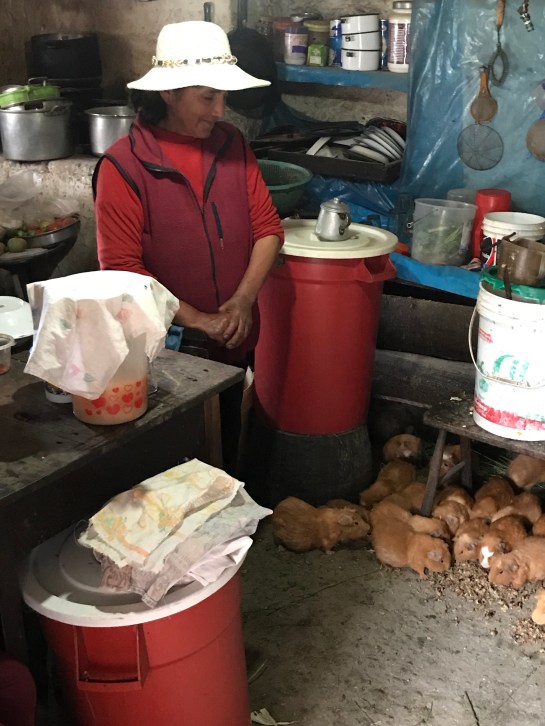
Guinea pigs are considered a delicacy in Peru. They are the preferred dish for festivals and holidays. They are served crispy complete with head, legs and eyes. Rachael and I loved and consumed many Peruvian dishes…. Guinea pig was not one of them.
The Guinea pigs are raised in the house and provide a productive use for kitchen scraps and discarded foods—the Chechuan alternative to our green bin. And indeed, that is what the guinea were doing in our brew master’s kitchen, consuming the remnants of the chica corn mash.
This bar atmosphere is one Rachael and I will long remember. Not sure that for either of us chica will replace a lovely gin martini though.
I will end this blog instalment here. Our time in the peru ecocamps was truly an amazing experience. Raul Montes, whom we met, is the owner and founder. Born in Cusco and having worked as a guide in the region, he wanted to create a different kind of tourism. His website states
“I began to formulate ideas of a socially responsible, adventurous trekking tours for the upscale traveler –the first of their kind in the Andean region of Peru.
PeruEcocamp has been conceived to bring travelers to the Mount of Salkantay area, while ensuring the social well-being and economic development of local communities.We are now living the Peru Ecocamp dream, and we are looking towards a future filled with enormous possibilities, as the very first project of this type in Peru. Our concept is one that prioritizes concern for the environment, coupled with eco-friendly development that is sustainable over time. Our goal is to benefit our strategic partners, while at the same time working on skills building and job creation initiatives for the local communities who form part of the Peru EcoCamp family.
Our destination the next day was Machu Picchu. That story requires a full blog on its own. So more to come.


 gmarkvoort