
Berlin, early musings
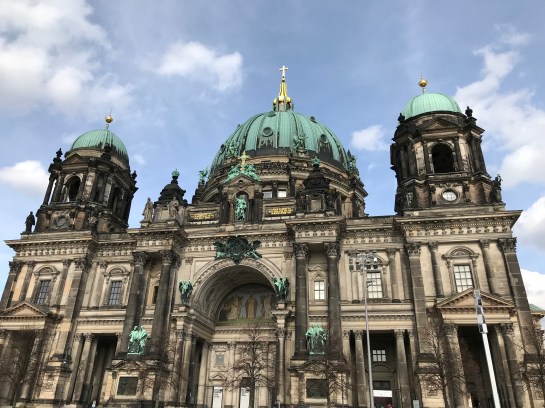
I am about to complete my first week in Berlin.
Berlin is at the same time appealing, fascinating and confusing. Although I will remain here for a full month, I anticipate I will not ,in this time, be able to fully grasp all its features, or to come to grips with what is essentially so Berlin.
Last night I attended Mozart’s Die Zauberflote, The Magic Flute. It was a beautiful warm evening and I was seated outside watching all the opera goers entering in their finery ( delightfully, people dress for Opera). I was joined by an older woman, ein Berliner, also waiting for her companions before entering. I was commenting on the beauty before us as we sat in the sun looking down Unter den Linden. She had learned that I had studied modern European history in Munich over 40 years ago. She smiled and sighed simultaneously and said yes we have such history, much of it beautiful and so much of it schwer. Schwer, meaning heavy and burdensome. Perhaps this conversation best describes my frames of Berlin to this point. I have found much of it beautiful and delightful. But it is impossible not to be confronted by the schwer wherever I go. I anticipate as I describe my first week, you will find these frames set side by side, juxtaposed.
Berlin, vibrant, current, livable. Die Mauer, remnants of a divided city. Berlin, Hitler’s capital, schwer, a dark history, destruction and reconstruction. Berlin home to art and culture.
So to begin.
I have a lovely apartment in Pretzlauer Berg. It is in a five story structure built in an inner courtyard off Hagenauer Strasse. Delightfully my charming Airbnb apartment is on the main floor and I have the enjoyment of my own private garden, where I currently sit typing my blog. Mercedeh Sanati of Quench Trip Design is my go to guide of where to go and stay. She directed me to find an apartment in the trendy cool district of Pretzlauer Berg. Situated in what was formerly East Berlin, it was largely untouched by the IIWW, but its classic old apartment blocks, factories and brauerei deteriorated under communist rule. Today it has seen a typical urban revival as professionals with young families abound along with bars and cafes. My first walk in my new ‘hood’ was a great delight…a warm beautiful evening strolling through an awakening Pretzlauer Berg. The first week of April and temperatures in the high teens and low 20s have me thoroughly enjoying the markets, parks, cafes and shops in this appealing neighborhood.


My guests will start to arrive in week two, so I always try to get a feel for the city I will call home for a month in my first few days. While I keep telling myself I should do the Hop On Hop Off tours to get a perspective on the city, I always find myself simply walking to where I want to go or taking the transit ( which is very good in Berlin–great tram, bus and subway service) to another neighborhood I want to explore. In this first week I have logged almost 60 kms walking the streets and allees of Berlin. Bretzlauer Berg is centrally located so possible to actually walk to many of the destinations I have on my list.
In my first day I walked to the centre in about 45 minutes. Large open spaces still hint at the devastation caused by the bombing of Berlin, but cranes and construction everywhere give testament to a city that is still in the reconstruction process.


Architecturally it is a confusing city. So much of Berlin was bombed or demolished following the war to be rebuilt by differing east/west visions and needs and subsequently by reunification realities.
The famous grand boulevard Unter den Linden continues its appeal. It was established in the 15th century as a carriage way from the Berlin Palace to the Prussian Royal Families hunting ground ( today the Tiergarten Park). The Berlin Palace is currently being rebuilt on the Museum Insel. The Palace was demolished by the East German government following the war. Today’s rebuild is apparently also controversial as the city of Berlin decided to knock down the Palast der Republik, the East German parliament to make way for it. The StaatsOper ( the Opera House) was also destroyed twice by bombs during the second world war.


Rebuilt once during the war and then again afterwards, it has recently reopened following a full renovation to bring it up to date for today’s opera acoustic needs.
Unter Den Linden was named for its thousand linden trees ( lime trees). Beloved by Germans, when Hitler cut many of them down to make way for his Nazi flags, discontent forced him to replace some of them. In the last days of the war, most of the trees were cut down for firewood. Luckily, they were replanted in 1950. The street was situated in East Berlin post war. Museum Insel which houses many of the cities museums, Berlin’s Humboldt university and the Opera house grace this beautiful boulevard which ends at the historical Brandenburg gate.
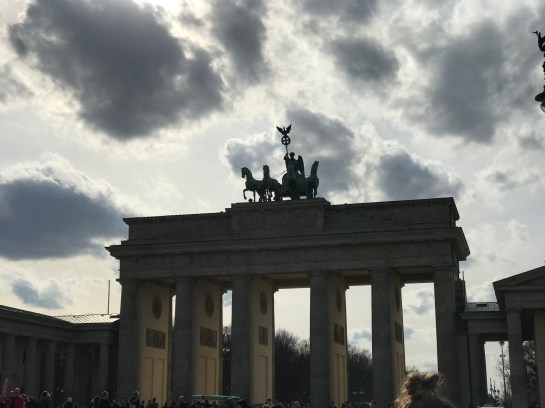
The East West Berlin wall ran alongside the Brandenburg gate. Prior to the building of the wall, many west berliners regularly visited the cultural sites along the Unter den Linden.


A former guardhouse, the Neue Wache, has become a universal memorial to the victims of war and tyranny. In
Indeed as I reflect on my walks down Unter den Linden and recall my conversation with die alte Berliner, Berlin is beautiful and schwer.
 gmarkvoort
I feel like I am there in Berlin with you. I am looking forward to the rest of “our” stay in such an interesting city.
LikeLike