
The Berlin Wall Part 2 Die Gedenkstatte Berliner Mauer :The Berlin Wall Memorial
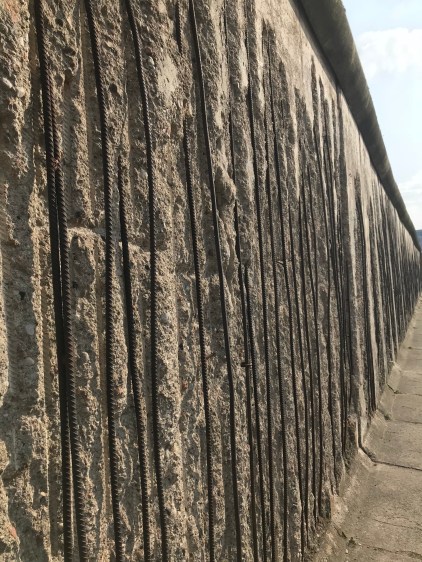
The Memorial to the Berlin Wall is situated in the western part of Berlin. While the centrally located Checkpoint Charlie has become a kitschy over the top tourist site, the Memorial has been thoughtfully designed and delivered.


My first view of the Berlin Wall Memorial occurred on my first day in Berlin as I was taxiing to my Airbnb apartment. I noticed an interesting wall of tall steel posts that stretched along the road. Almost immediately I sensed I was looking at the former wall. This section of the wall is very close to my apartment and so the next day I took a walk.
While there are two buildings to visit if you wish (the Visitor Centrum and the Berlin Wall documentation Centre), I found the best way to experience the Memorial is to simply walk the exhibit. It stretches for about 8 blocks.


As you walk the wall you see that ‘die Berliner Mauer’ cut right through a living, breathing neighborhood.
The installation is a very thoughtful and thorough representation of the wall, its physical, emotional and psychic impact on a divided Berlin. The line of steel posts as well as a surviving intact portion of the ‘wall system’ deliver a punch as you consider how it divided a former neighborhood.
As you walk the wall path, you find other posts—they contain photos, written documents, and recordings which provide actual stories of those who lived in the area during the 60s-80s, how the wall was built, how the wall fell, the timeline and details of the ‘wall system’, the attempted escapes over the wall as well us through underground tunnels.

The Window of Remembrance monument presents those who lost their lives in attempting to escape from East Berlin. The black and white photos, the dates of their birth and the date of their deaths at the wall hit hard. While there I found a picture of a young man Werner Kuhl ( the one on the left below), born within a year of my birth, who attempted to escape the year that I visited in 1971. Hard to grasp that the wall took his future.

The first defector to escape across the Berlin Wall was 19-year-old East German border guard Corporal Conrad Schumann, who was immortalized on film as he leapt over a 3-foot-high roll of barbed wire just two days after East Germany sealed the border. At that time, a simple roll of barbed wire had been erected..he simply pushed a portion down each time he walked that part of the border on his patrol walk. Signaling to the West German police his intentions, who called the press, he eventually jumped and made his escape.
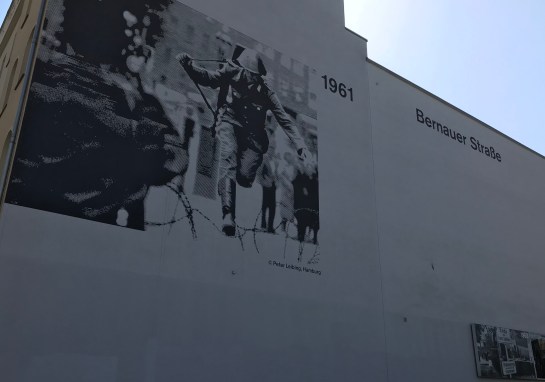
His photo is memorialized on the wall of the building along the ‘mauer’ walk.
Over time considerable additional barriers were erected by East Berlin border patrol to stop the flow of East Berliners fleeing to the West. Eventually, s 12-foot-tall, 4-foot-wide mass of reinforced concrete was topped with an enormous pipe that made climbing over nearly impossible.

Behind the wall on the East German side was a so-called “Death Strip”: a gauntlet of soft sand (to show footprints), floodlights, vicious guard dogs, trip-wire machine guns, anti-vehicle trenches and patrolling soldiers with orders to shoot escapees on sight. The Mauer Walk provides a real insight into the size of the strip and difficulties it presented to escapees.
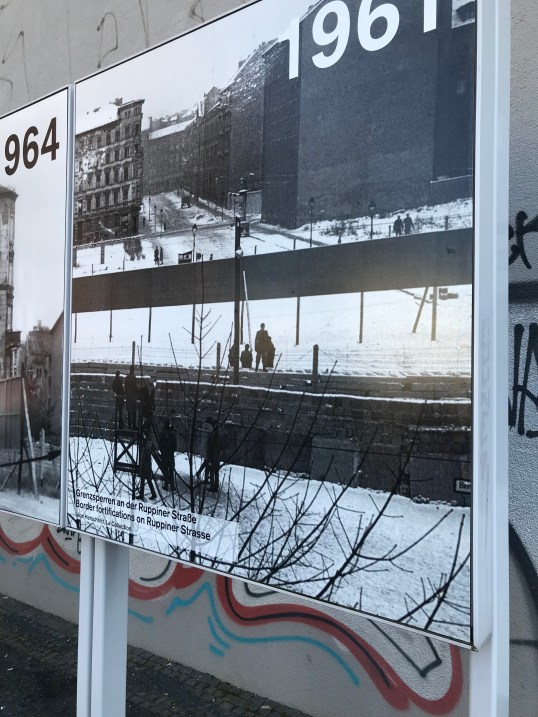
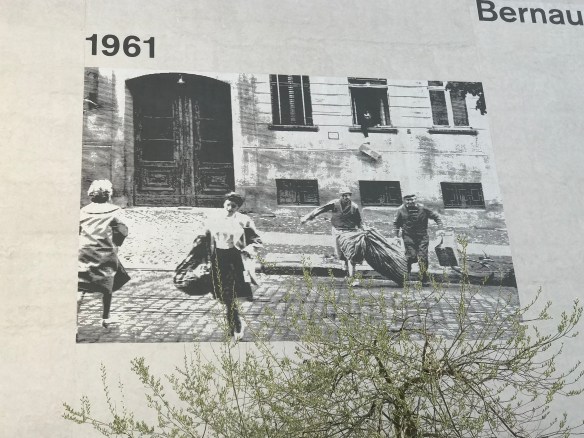
At least 138 people died trying to cross the border. While some did make it safely across, it is unclear how many people exactly reached the western part. Some estimates claim that 5,000 East Germans reached West Berlin. Many of these occurred early on in the mass escapes.
The first victim was Ida Siekmann, who died on August 22, 1961, after attempting to leap to a West Berlin street below her fourth-floor East Berlin apartment window. Others who did leap out of buildings were caught by West Berlin fireman. The last fatality occurred in March 1989 when a young East German attempting to fly over the wall in a hot air balloon crashed into power lines.
Large photos of escapees, the former wall and the neighborhood on the side of building walls along the path provide a clear depiction of various stages of life during the 28 years the wall separated Berlin.


The picture above on the right, really impacted me. You can clearly see a mother standing on a chair, holding up her daughter…perhaps you can’t see it but far off in the distance on the right side is an old woman, mother of the woman and granddaughter to the child, waving back. Families separated by a wall and the ‘death strip’. Pictures on the left show other West Berliners, standing on ladders waving to friends and family.
One of the most impactful memorials, deals with the effect of the wall on those who lived on Bernauer Strasse. This street, the heart of an urban space, was cut in half by die Berliner Mauer. It separated families, friends, and people from their local shops. On the morning of August 13 1961, neighbors awoke to a barbed wire fence running through their kieze, and many were cut off from streets they always traveled. On Bernauer Strasse the border ran directly in front of their homes. Residents in these buildings initially walked out their front doors to freedom, and after the eastern guards evicted the first floor residents, they jumped out of the 2nd and 3rd stories—some seriously injuring themselves—the first ‘wall’ fatalities occurred here. Overtime, all the residents on the east of the border were evicted, all windows and doors bricked up and eventually they were destroyed . The East Berliners in this area continued their resistance and attempts to escape… they built escape tunnels, they scaled the walls and ran the ‘death strip’. This neighborhood conveyed the lack of alignment between the population and the East German leadership.


In the picture on the left the path of the escape tunnel 57, named for the 57 people who escaped through it. I was surprised at the number of tunnels built yet the lack of success in making this a real way of escape.
The picture on the right shows the foundation of one of the Bernauer Strasse houses that were destroyed after its owners were evicted. The green space beyond had been a row of apartment blocks housing businesses and families.
Not surprisingly, on the night of November 9 ,1989, the first segments of the ‘wall’ were knocked down by the citizens at the crossing between Bernauer and Eberswalder Strasse, creating the first free crossing between East and West Berlin. On that night the head of the East German Communist Party declared that East German citizens could cross the border whenever they pleased. It was expected that an orderly bureaucratic approach to the new access would be developed. This did not happen. On hearing the news, ecstatic crowds swarmed the wall, crossing the borders, taking picks and hammers to the wall. I expect many of those reading this blog may well remember the pictures of the triumphant crowds on the wall in front of the Brandenburger Tor. Over that following weekend more than 2 million people crossed the borders, visiting family, friends and neighborhoods they had not seen for 28 years. Berlin was one awesome street party, united for the first time since 1945!!!
One year later the reunification of East and West Germany occurred. On October 3, 1990 Germany finally became one country again.
 gmarkvoort
Many thanks Geri – I love reading your blogs. Although I only spent four days in Berlin, I visited many of the areas you have written about and appreciate the in-depth commentary you provide on them. Enjoy the rest of your stay. It is still cold here, so you left at the right time. / Audrey
LikeLike
Geri You are such a great writer. You description of Berlin makes it real . Please keep blogging. Miss you Barb
Sent from my iPhone
LikeLike